The Letter and the Urn
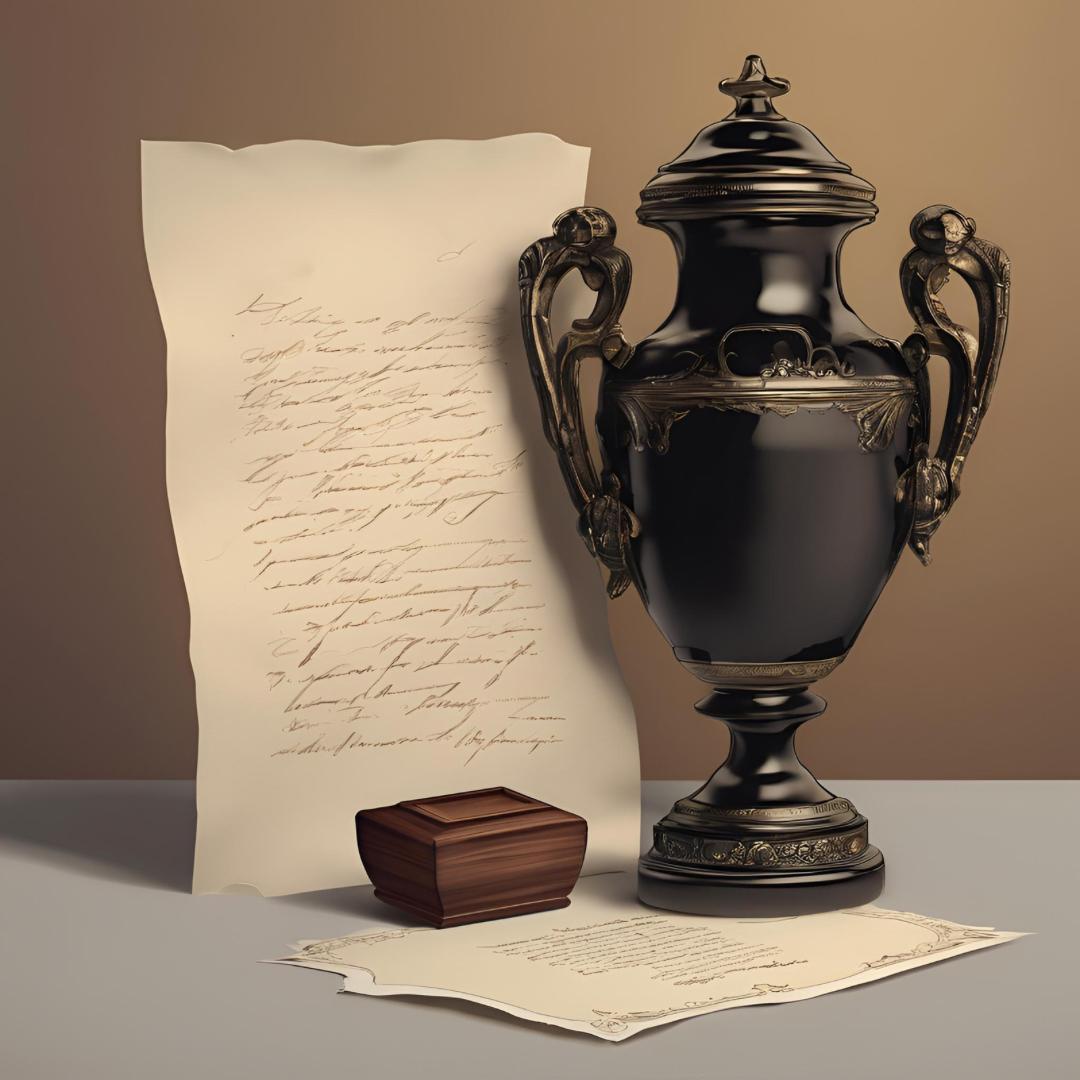
Berenice
did not understand why she had been summoned to that reading of the will. She
did not know the deceased, a certain Aldo Schmidt, nor any of the relatives and
friends who yearned for a share. Even so, she made a point of arriving on time
and sat down before everyone else, driven by immense curiosity. Surely, they
had confused her with a namesake. Berenice Ananias Louzada de Alcântara? No! It
was impossible for another to exist. Good Lord, it could only be her!
Despite
never having seen those people before, no one seemed to find Berenice's
presence strange. Everyone was more interested in the lawyer's voice as he read
the last wishes of his former client, who had died of some old-age illness
exactly 36 days ago. He had been cremated, and his ashes carefully placed in an
urn resting on a hardwood bookshelf. Judging by its reddish hue, it was
obviously mahogany.
After
little more than 10 or 15 minutes of reading, the chatter began among those who
had not been left so much as a penny. Nearly everyone, in fact, except for the
goddaughter, the maid's only daughter. A confirmed bachelor that he was, he
left no direct heirs, only cousins and nieces and nephews. But why had the
deceased insisted on his extended family being present? His intention to mock
that pack of parasites one last time was obvious. Surely, Aldo was laughing
hysterically from the beyond, while the living, on this side, cursed him.
And
the hubbub continued. Berenice struggled to keep her face rigid, wanting to
conceal any expressions that might trigger conflict. Facing the floor, she knew
her eyes would betray her if anyone caught them. Quiet. Absolutely static.
Within a few minutes, which felt like hours, the small crowd began to disperse,
until the woman found herself alone with the lawyer. A deathly silence took
over the room, soon broken by the woman.
"Sir,
why was I called, since I have never even heard of this Smith?"
"Schmidt."
"Whatever!
I have not the slightest idea who this man was."
Silent,
the lawyer stood up and walked toward the bookshelf. He took the urn and an
envelope beside it. He turned around, intending to hand them to the woman, who
understood nothing.
"Why
are you giving me these things?"
"Mrs.
Berenice, I am merely the lawyer. I know nothing about this envelope. But Mr.
Schmidt instructed me to deliver it to you. He told me that you would
understand everything as soon as you read the letter which, I suppose, is
inside this envelope."
"A
letter?"
"Yes,
there is a letter inside the envelope."
Despite
her bewilderment, the woman stretched out her arm and nearly snatched the
envelope from the lawyer's hands. She examined the object carefully, while the
man, still standing and holding the urn, simply watched her. Berenice tore the
envelope along the side and pulled out a letter, written in a trembling but
legible hand.
“I
leave you nothing of material value, for I well know you are a woman of means.
How do I know? I made you so. And before you tear or crumple this missive, let
me explain.
As
you well know, my parents named me Aldo Schmidt. I was born on 12/12/1912—a
curious date, to say the least. But it has nothing to do with the case at hand,
unless you believe in astrology. I believe you do not, judging by the length of
your mourning, which I followed closely, like the fetish of a diseased mind.
Our
stories crossed nearly 60 years ago, when I, still a young man of 23, was
thoroughly disgusted with life. Certainly not for a lack of choices, for I had
them in droves. Money did not fail me, as I was born predestined to a life of
luxury. However, having the world at my feet did not seem enough for such
profound anguish.
After
the celebrations welcoming 1936, there I was, sunk, in every sense, into the
wide sofa on the veranda of my parents' house. Bored by so many drinks, I
reached for a cigarette on the coffee table. No sooner had I lit it than I
noticed the arrival of Rita, one of the maids, who carried a wastebasket and
began picking up the scraps from the night before. I looked at her with
contempt and imagined myself crushing that being, who held no value in my eyes
back then.
I
pulled myself up and went for a stroll across the vast estate. One cigarette
gave way to another, and then four or five more. I remember stopping by the
swimming pool, where an enormity of insects lay at the bottom. There was a
beetle, still alive, on the surface, trying to free itself from the fate of
joining its peers. I watched it for perhaps half an hour, until the wretched
thing lost its strength and, defeated, sank slowly. A pleasure, hitherto
incomprehensible, washed over my body.
It
was not long before I found myself outside the walls of the estate that would
soon be mine, as my parents died nearly two years later in a fortuitous car
accident. I say fortuitous, for it was the third pleasure I felt, taking into
account the tragic end of that beetle. However, neither the first nor, much
less, the third interests you. Only the second, which was precisely the one
that entwined our destinies.
As
I was saying, there I was, walking further and further from the walls, when I
decided to go to the lake which, as you well know, is about an hour away,
depending on the mood of the walkers. I sat in a huge clearing facing the
placid waters. I stayed there for I don’t know how long, until I heard voices.
I turned my head and noticed they were two men, slightly older than me, but who
had not yet reached 30, as I learned a few days later.
One
was slightly taller, stocky, with hair that was practically black. The other
was slender, almost blonde, with very light brown eyes. I will not describe him
in greater detail, because I am certain you could do it much better. After all,
he was your late husband.
Those
two had gone there to fish. They put their gear under a tree and spoke about
something I could not catch, despite my attentive ears. Be that as it may, your
husband grabbed a tin can and a small trowel. He took a few steps toward a
softer patch of earth, where he began digging around for worms. His friend took
off his shoes and socks and walked toward the water's edge, where he placed his
feet and scooped up some water with his hands to splash on his face.
I
do not know exactly why I did it, but I know I did. I picked up a robust piece
of wood beside me and, determined, walked toward your husband. I approached
like a feline and, without thinking, dealt him a swift, precise blow to the
back of his neck. Not a single groan. He fell like a ripe fruit. Only the
muffled sound of his face hitting the damp earth.
I
hurriedly left the scene before the other man could notice my presence. I do
not remember looking back until I returned home, where I went straight to the
pool. The beetle was still there, motionless, alongside its own. I believe I
was successful, since, as far as I have known ever since, your husband's friend
never mentioned seeing anyone that day.
With
no more convenient suspects, the police ended up arresting your husband's
friend. They tortured him until the man finally succumbed and confessed to
murdering his friend. The motive, according to the investigation, would have
been more obvious if the dead man had been him, since, as you well know, he was
your lover. That detail, however, was suppressed from the case files. Not that
the police wanted to protect you from such a scandal. It was nothing more than
a request of mine, generously greased with payment.
With
this gesture, which may seem like one of kindness to you, I did you the favor
of keeping your reputation unsullied as a lady of society. Had I not had that
impulse, you certainly would not have inherited the late man's fortune, which,
as we well know, was enough to make even the one I inherited envious.
As
for the self-confessed murderer, whom I now reveal was merely a scapegoat for
the police's incompetence, he was sentenced to 28 years in prison. He did not
serve two, because, as we know, he hanged himself in his cell. Poor soul.
Catholic that he was, it seems to me he allowed himself to succumb to the sin
of suicide. May God have mercy on that poor soul!
To
conclude, I hand my ashes over to you. Do with them as you wish. Let it be for
the best or for the worst. I do not care. I know I have fulfilled my destiny,
and I hope that you, too, fulfill yours.
Sincerely,
Aldo
Schmidt”
Berenice
turned the page. Not another word. She stood up, slipped the letter into her
purse, stared blankly at the lawyer, snatched the urn from his hands, and
walked away.
%20(1).jpg)
.jpg)
Comentários
Postar um comentário